Door Assembly
Sections, stiles, hinges, struts, reinforcement, windows, handles, weather seals, and the bottom retainer form the moving door.







Learn the names and purposes of garage door sections, springs, cables, drums, rollers, hinges, tracks, seals, opener hardware, safety sensors, and the other components that help your door operate safely.
A sectional garage door includes door sections, hinges, rollers, tracks, brackets, weather seals, reinforcement, and a counterbalance system made from springs, cables, drums, bearings, and related hardware. An automatic system also includes an opener, rail, trolley, door arm, controls, safety sensors, and emergency-release mechanism.
A sectional garage door is not a single piece of equipment. It is a coordinated system in which structural, moving, counterbalance, sealing, and automatic-operating components must work together.
Sections, stiles, hinges, struts, reinforcement, windows, handles, weather seals, and the bottom retainer form the moving door.
Rollers, vertical tracks, curved tracks, horizontal tracks, jamb brackets, flag brackets, and ceiling supports guide the door.
Springs, shafts, bearings, drums, pulleys, lift cables, anchor brackets, and bottom brackets help support and control door weight.
The motor unit, rail, trolley, drive system, opener arm, controls, sensors, wiring, and emergency release automate door movement.

These components form and strengthen the moving door. Damage to the sections or internal reinforcement can affect alignment, appearance, weather resistance, opener attachment, and safe operation.
Horizontal sections stack above one another to form a sectional garage door. Each section bends through the curved track as the door opens and straightens again as the door closes.
Stiles are vertical reinforcing members located on the inside of many door sections. Hinges, roller carriers, struts, and opener reinforcement may attach at or near these structural points.
Struts span across the inside of a door section to increase rigidity and help resist bowing. Adding, removing, or changing a strut alters door weight and may affect the counterbalance system.
Top fixtures or top roller brackets position the upper rollers so the top section seals properly against the header and follows the track during movement.
A reinforcement bracket distributes the opener arm’s pulling and pushing force across the top section. A weak attachment can crack, bend, or tear the top section.
Window frames, glazing, and decorative inserts add light and style but also affect the section’s weight and construction. Replacement parts should match the door design.
Properly installed handles provide safer gripping points during manual operation. Fingers should stay away from section joints, hinges, rollers, and tracks.
The shaped edges between sections help the door seal and bend through the tracks. Crushed, separated, or badly misaligned joints may create binding and pinch hazards.
The counterbalance system offsets most of the garage door’s weight so the door can move more easily by hand and with an automatic opener. The correct spring system must match the door’s weight, height, construction, track configuration, and operating requirements.
Torsion springs are commonly mounted on a shaft above the door. As the door closes, the springs wind and store energy. As the door opens, that energy helps rotate the shaft and cable drums.
Extension springs commonly stretch alongside the horizontal tracks. Pulleys and cables transfer their lifting force to the door. Proper containment or safety cables are important.
Center brackets, stationary cones, winding cones, end bearing plates, spring pads, and fasteners support and position torsion spring components.
The shaft carries the torsion springs, cable drums, and bearings. Rotation of the shaft coordinates cable movement on both sides of the garage door.

These components transfer and control the lifting force created by the spring system. A problem on one side can make the garage door crooked, jammed, heavy, unstable, or unsupported.
Steel lift cables connect the lower portion of the door to the counterbalance system. They wrap around cable drums in many torsion systems or travel through pulley arrangements in extension systems.
Cable drums are mounted near the ends of a torsion shaft. Their grooves guide the lift cables as the shaft rotates and the door opens or closes.
End bearings support the torsion shaft near the cable drums and allow the shaft to rotate. Worn bearings may create drag, vibration, noise, or uneven movement.
Some torsion systems use a center bearing or bushing near the spring anchor bracket to support shaft rotation and maintain alignment.
Bottom brackets attach near the lower corners of the door and commonly serve as lift-cable attachment points. They may remain under cable and spring tension.
Extension-spring systems commonly use stationary and moving pulleys to route cables and transfer spring force. Worn pulleys can wobble, bind, or damage cables.

Do not pull, cut, clamp, rewrap, or reposition a loose cable. Do not loosen cable drums, set screws, bottom brackets, or spring hardware. Keep people and vehicles clear and schedule professional service.
Call 903-364-6364
Hinges allow the door sections to bend as the door travels through the curved tracks. Rollers support and guide the door along its intended path.
Center hinges connect adjacent sections across the interior of the door and allow controlled movement at each section joint.
End hinges connect sections near the outer edges and hold roller stems at specific positions so the door follows the track.
Nylon rollers may reduce operating noise. Designs vary from basic non-bearing rollers to sealed or ball-bearing versions.
Steel rollers are durable and common on many residential and commercial doors but may produce more operating noise.
The stem slides through the hinge or roller carrier. Excessive movement, bending, rust, or wear may affect alignment.
Bearing condition affects how smoothly the roller turns. Missing, dry, contaminated, or worn bearings may create drag and noise.
Worn rollers, loose hinges, damaged tracks, cable problems, bearing resistance, or poor balance can place additional stress on the door, opener, sections, and surrounding hardware.
Track hardware establishes the path the garage door follows. Track spacing, alignment, attachment, radius, support, and roller position all influence smooth movement.
Vertical tracks run upward beside the door opening and guide the door during the lower portion of its travel.
The curved portion transitions the door from vertical travel to horizontal travel as the sections bend through the opening.
Horizontal tracks support and guide the open garage door above the garage floor.
Jamb brackets connect vertical track assemblies to the framing beside the garage door opening.
Flag brackets connect and support portions of the vertical and horizontal track assemblies near the upper corners of the opening.
Fasteners and clips connect track sections and brackets. Loose or missing hardware can allow movement and affect roller alignment.
Angle iron or approved support hardware secures the rear of the horizontal tracks to the ceiling structure.
Track stops or bumpers limit roller travel and help prevent the top rollers from leaving the rear of the horizontal tracks.
Remove loose dirt, leaves, cobwebs, and debris that could interfere with roller travel. Avoid coating the inside of the tracks with thick grease that can collect dirt.
Bent, loose, separated, or badly misaligned tracks should be inspected professionally. Forcing or striking track assemblies may worsen the alignment or release unstable door hardware.
These components help reduce air, light, moisture, insects, and debris around the closed door while supporting manual operation and security.
The flexible bottom seal compresses against the floor when the door closes. Common wear includes flattening, cracking, tearing, shrinking, hardening, or pulling out of the retainer.
A metal or vinyl retainer attaches to the bottom section and holds the replaceable bottom seal. Retainer shape and channel style must match the selected seal.
Perimeter weatherstripping seals the sides and top of the closed door. It should contact the door without preventing smooth movement.
Some garages use a floor-mounted threshold to reduce gaps caused by an uneven slab. It must be positioned so it does not interfere with safe closing or reversal.
A manual slide lock extends into the track to secure a closed door. The lock must be disengaged before operating an automatic opener.
Some manually operated doors use an exterior keyed lock connected to interior lock bars. Automatic-opener installations may use different locking arrangements.
Handles provide safer gripping points when manually operating the door. Avoid gripping section joints or placing fingers near rollers and tracks.
Garages without another entry may use an exterior emergency-release system that allows the opener trolley to be disconnected during a power outage.
The opener does not replace the spring system. It automates a garage door that should already be properly balanced, aligned, supported, and capable of moving smoothly by hand.
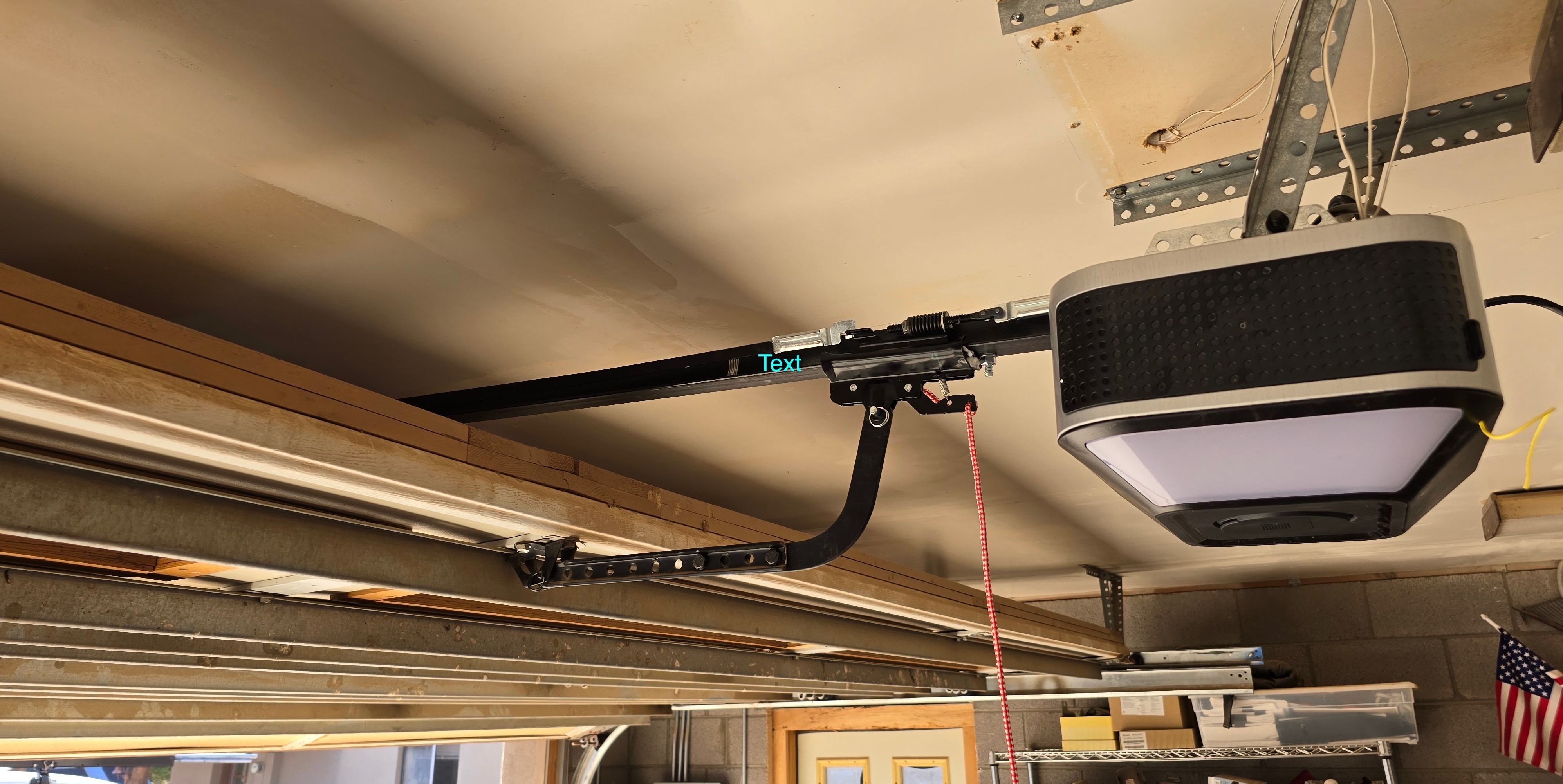
The ceiling-mounted motor unit contains the motor, controls, lighting, drive components, and electronic logic on many openers.
The rail extends from the motor unit toward the header and guides the trolley during opening and closing.
The trolley travels along the rail and connects the drive system to the opener arm and garage door.
Depending on the opener design, a chain, reinforced belt, or threaded drive mechanism moves the trolley.
The connected arms transfer movement between the trolley and the top section of the garage door.
The header bracket supports the front of the opener rail and must be securely attached to adequate structural framing.
This bracket connects the opener arm to the top section, commonly with reinforcement selected for the door construction.
The red release handle disconnects the trolley so the door can be operated manually when conditions are safe.
These components communicate with the opener, control access, monitor the closing path, provide warnings, and support convenient operation.
A sending sensor and receiving sensor create a beam across the opening near the floor. The opener should respond when the beam is interrupted during closing.
Brackets position the sensors while low-voltage wiring connects them to the opener. Bent brackets, damaged wire, loose connections, dirt, or misalignment may affect operation.
The interior wall control operates the opener and may include lights, lock modes, motion sensing, maintenance alerts, or programming features.
Handheld or vehicle-mounted remotes transmit a coded signal to the opener. Batteries, programming, radio interference, or damaged controls can affect performance.
Exterior keypads provide coded entry without a remote. Some models support temporary codes or multiple users.
Compatible openers may include a battery that provides limited operation during a power outage. Batteries require periodic testing and eventual replacement.
Wi-Fi or app-connected openers may provide status notifications, remote control, schedules, cameras, or access-sharing features.
Some openers flash lights or sound warnings before unattended or remote closing. Warning features should not be bypassed.
Understanding the sequence helps explain why a problem with one component can create symptoms throughout the rest of the system.
The opener arm pushes or pulls the top section, or the user lifts the door manually using an installed handle.
Torsion springs wind or unwind, or extension springs stretch or contract, as the door changes position.
Lift cables move with the drums or pulley system and apply lifting force near the lower corners of the door.
Hinges pivot as each section approaches and passes through the curved portion of the track.
Rollers travel through the vertical, curved, and horizontal tracks while supporting the moving door.
Brackets, fasteners, and ceiling supports hold the track system in position as the door moves.
At the closed position, the bottom, side, and top seals help close gaps around the door.
The opener monitors sensor input, travel, and resistance while controlling automatic movement.
A change in noise, speed, movement, alignment, or manual effort often provides an early warning that one or more components need attention.
May involve rollers, bearings, hinges, tracks, opener components, or metal parts rubbing because of alignment problems.
May involve a damaged spring, binding section, worn hinge, shifting hardware, or a component releasing under load.
A loose or improperly tracking cable may strike the door, track, wall, or surrounding hardware during movement.
One side rising before the other may indicate cable, drum, roller, track, spring, or bottom-bracket problems.
Unusual manual weight may indicate insufficient spring support, binding hardware, or counterbalance failure.
Excessive upward movement during a balance test may indicate too much spring force or another counterbalance issue.
May result from worn rollers, loose tracks, binding hinges, cable movement, poor balance, or opener attachment problems.
Corrosion, broken cable strands, cracked rollers, bent hinges, or damaged brackets deserve professional evaluation.
A top section that bows or folds may lack proper reinforcement or may be experiencing excessive opener force.
The opener may be reacting to sensor trouble, binding, improper travel, excessive resistance, or mechanical door problems.


Two components may look similar while having different dimensions, material thickness, strength, weight rating, hole pattern, geometry, corrosion resistance, or intended application.
Manufacturer information, labels, model details, and original installation documents may help identify the correct component.
Springs, cables, drums, hinges, rollers, struts, and opener reinforcement must suit the size and weight of the door.
Standard lift, low headroom, high lift, vertical lift, and other track arrangements may require different hardware.
Substituting hinges, struts, tracks, fasteners, brackets, or sections can affect the tested strength or approval of a wind-rated door.
Spring design, drum profile, cable length, shaft arrangement, and door travel must work together.
The opener, reinforcement, controls, sensors, rail, and accessories must be compatible with the door and opener model.
Homeowners can perform careful visual checks and basic cleaning, but tension-loaded, structural, electrical, and alignment-sensitive repairs should be handled professionally.
Dynamic Door Service can inspect the entire system, identify the failed component, explain the repair, and verify safe operation.
We recommend professional garage door maintenance and a complete safety inspection once a year. An annual visit helps identify worn, loose, damaged, dry, misaligned, or unsafe components before they cause a larger repair or leave the door inoperable.
We inspect the complete garage door system, explain what each problem affects, and identify parts that are worn, damaged, loose, incompatible, improperly adjusted, or potentially unsafe.
Select a question to view the answer.
The main parts include door sections, stiles, hinges, rollers, tracks, brackets, struts, weather seals, springs, lift cables, cable drums, bearings, bottom brackets, opener hardware, controls, and safety sensors.
Homeowners often use the words panel and section interchangeably. A sectional garage door is typically made from several horizontal sections connected by hinges. Each section moves through the curved tracks as the door opens.
The spring and counterbalance system supports most of the door’s weight. Springs work with cables, drums, pulleys, shafts, bearings, and bottom brackets to help lift and control the door.
The best roller depends on the door, expected usage, bearing design, environment, noise preference, and manufacturer requirements. Quality nylon rollers may operate more quietly, while steel rollers are common in heavier-duty applications.
The inside of the tracks should generally remain clean rather than coated with thick grease. Lubricate approved moving parts according to the garage door manufacturer’s instructions.
No. Spring color provides only partial information. Correct spring selection also depends on wire size, inside diameter, length, wind direction, door weight, track configuration, and other design requirements.
No. Lift cables commonly attach near the bottom brackets, and the brackets may remain under significant spring and cable tension. Bottom-bracket service should be performed by a trained technician.
The opener arm applies repeated pushing and pulling force to the top section. Correct reinforcement distributes that force and helps prevent the section from bending, cracking, or tearing at the opener attachment.
Not always. Similar-looking parts may differ in material thickness, strength, dimensions, rating, geometry, or intended use. Replacement parts should be selected for the specific door and application.
We recommend professional garage door maintenance and a complete safety inspection once a year. High-use residential and commercial doors may need service more frequently.
Yes. Every Dynamic Door Service visit includes a full safety inspection of the door, hardware, spring system, cables, rollers, tracks, opener, sensors, balance, movement, and visible safety concerns.
Dynamic Door Service provides complete garage door inspections, maintenance, spring replacement, cable repair, roller and hinge service, track repair, opener service, and safety evaluations throughout East Texas.

Copyright 2026. DYNAMIC DOOR SERVICE TX LLC. All Rights Reserved.


